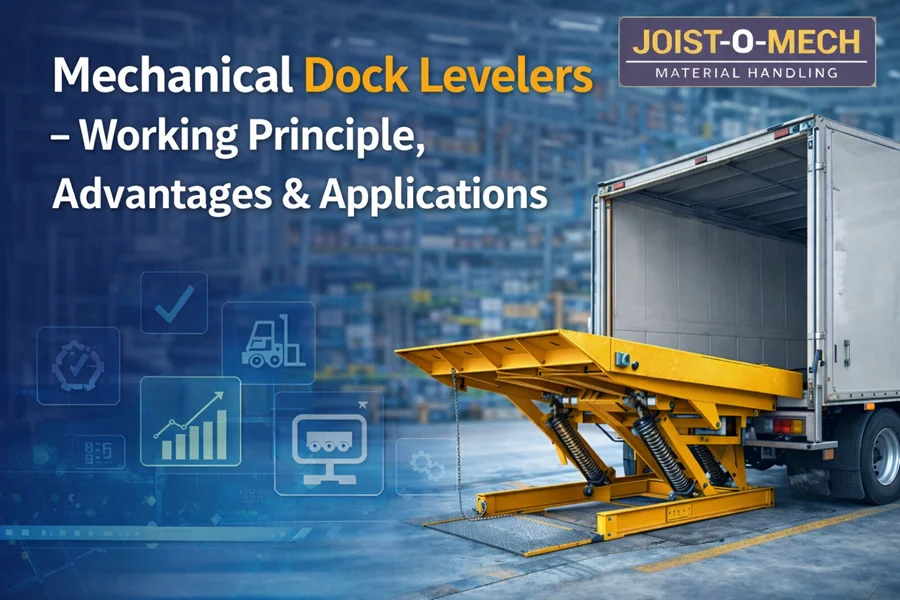
Warehouse loading docks are among the most critical yet high-risk zones in any industrial facility. Every day, forklifts, pallet trucks, and operators move tons of material between warehouse floors and transport vehicles. Even a small mismatch in height between the dock and the truck bed can result in unsafe working angles, product damage, or operational delays.
This is where mechanical dock levelers continue to play a vital role. Despite the availability of powered alternatives, mechanical dock levelers remain widely used across Indian warehouses due to their simplicity, reliability, and suitability for specific operational conditions.
This article explains the working principle, advantages, and applications of mechanical dock levelers, helping warehouse owners, plant heads, and logistics managers decide when this type of dock leveler is the right choice.
What Is a Mechanical Dock Leveler?
A mechanical dock leveler is a manually operated piece of loading dock equipment designed to bridge the vertical gap between a warehouse dock and a truck bed. It uses a spring-based counterbalance mechanism to raise and position the dock platform, allowing forklifts and material handling equipment to move safely between surfaces.
Mechanical dock levelers do not rely on electric or hydraulic power. Instead, they are operated using a pull chain and controlled release system, making them suitable for warehouses where simplicity and operational control are priorities.
In modern warehouses, mechanical dock levelers are typically used in low to medium traffic loading bays where load conditions are predictable and operational discipline is maintained.
Unlike powered dock levelers, mechanical systems depend more on correct operation and training, which is why understanding their working principle and limitations is essential before selection.
Working Principle of a Mechanical Dock Leveler
The working principle of a mechanical dock leveler is straightforward, but each step plays an important role in safe operation. Understanding this sequence helps warehouse managers ensure correct usage and avoid common handling issues.
Spring Mechanism
At the core of a mechanical dock leveler is a spring assembly. These heavy-duty springs store energy and counterbalance the weight of the deck platform. The spring tension is calibrated during installation based on platform size and load requirements.
This counterbalance allows the operator to raise the dock platform without excessive physical effort.
Pull Chain Operation
To operate the dock leveler, the operator pulls a manual chain connected to the release mechanism. This action disengages the hold-down system and allows the spring energy to lift the deck platform upward.
The chain pull must be firm and controlled, which is why operator training is critical in mechanical dock leveler operation.
Deck Lifting and Lip Extension
As the deck rises, the lip assembly automatically extends. The lip is the hinged edge of the platform that will eventually rest on the truck bed. Proper lip extension ensures sufficient overlap between the dock leveler and the vehicle, enabling safe forklift movement.
Resting on the Truck Bed
Once the deck reaches its peak height, the operator releases the chain. The platform then descends smoothly until the lip comes to rest on the truck bed. At this stage, the dock leveler forms a stable bridge between the warehouse floor and the vehicle.
Return to Stored Position
After loading or unloading is completed and the truck departs, the dock leveler is returned to its stored position. The lip folds back, and the deck settles into the dock pit, ready for the next cycle.
This simple mechanical sequence is why many facilities prefer mechanical dock levelers for controlled operations.
Key Components of a Mechanical Dock Leveler
Understanding the key components helps in maintenance planning and safe operation.
Deck Platform
The deck platform is the main load-bearing surface. It must withstand repeated forklift traffic, dynamic loads, and impact forces during operation. Deck thickness and reinforcement directly affect durability.
Lip Assembly
The lip bridges the gap between the dock leveler and the truck bed. Its length and strength determine how safely forklifts can transition between surfaces.
Spring Mechanism
The spring system counterbalances the deck weight. Proper adjustment ensures smooth lifting and controlled descent.
Hold-Down System
The hold-down mechanism keeps the dock leveler securely in place when not in use. It prevents accidental movement and ensures the platform remains stable during loading.
Safety Supports
Safety supports are engaged during maintenance or inspections. They prevent the deck from falling unexpectedly and are critical for technician safety.
Advantages of Mechanical Dock Levelers
The advantages of mechanical dock levelers are most evident when they are used in the right operational context.
Simple Operation
Mechanical dock levelers have a straightforward operating mechanism. With proper training, operators can quickly deploy and retract the platform without complex controls.
Lower Dependency on Power
Since mechanical dock levelers do not require electricity or hydraulics, they are suitable for facilities with limited power availability or backup concerns.
Cost-Effective for Low to Medium Usage
For warehouses with limited loading cycles per day, mechanical dock levelers offer a practical balance between functionality and operational cost.
Rugged Construction
Mechanical dock levelers are designed with fewer moving parts, making them inherently robust and less sensitive to environmental conditions such as dust and temperature variations.
Easy Maintenance
Routine maintenance primarily involves inspection of springs, hinges, and lubrication points. This simplicity reduces downtime when maintenance schedules are followed correctly.
Limitations of Mechanical Dock Levelers
Acknowledging limitations is essential for correct selection and safe operation.
Operator Effort Dependency
Mechanical dock levelers rely on manual effort. Improper handling or fatigue can affect consistent operation.
Safety Reliance on Proper Handling
Unlike powered systems with built-in controls, mechanical dock leveler safety depends heavily on operator discipline and training.
Not Ideal for High-Frequency Operations
In high-traffic loading bays, repeated manual operation can slow down throughput and increase wear.
These limitations do not make mechanical dock levelers unsuitable—but they do define where they should and should not be used.
Applications of Mechanical Dock Levelers
Mechanical dock levelers are best suited for specific industrial scenarios commonly found in India.
Small to Mid-Size Warehouses
Warehouses with predictable loading schedules and controlled traffic benefit from mechanical dock levelers.
Manufacturing Plants with Controlled Dispatch
Facilities where dispatch volumes are planned and not continuous often find mechanical dock levelers adequate.
Distribution Centres with Limited Dock Usage
Low-cycle docks used for occasional loading are well matched with mechanical systems.
Facilities with Power Constraints
Warehouses in locations with power reliability challenges often prefer mechanical dock levelers for uninterrupted operation.
Mechanical Dock Leveler vs Hydraulic Dock Leveler
| Parameter | Mechanical Dock Leveler | Hydraulic Dock Leveler |
|---|---|---|
| Operation | Manual | Push-button |
| Safety | Operator-dependent | Controlled |
| Usage Frequency | Low to medium | Medium to high |
| Maintenance | Simple | System-based |
| Ideal Facility | Controlled warehouses | High-throughput docks |
This comparison highlights that the choice depends on operational requirements, not technology preference.
Safety Considerations While Using Mechanical Dock Levelers
Safety practices are especially important in Indian warehouse environments where manpower density is high.
Key safety considerations include:
- Proper operator training
- Respecting load limits
- Using safety supports during maintenance
- Maintaining clean dock areas to avoid slippage
Consistent safety practices significantly reduce accident risks.
Common Mistakes Warehouses Make with Mechanical Dock Levelers
- Overloading beyond rated capacity
- Allowing untrained operators to handle the equipment
- Skipping preventive maintenance
- Using mechanical dock levelers in high-traffic bays
Avoiding these mistakes improves reliability and extends equipment life.
When Should You Choose a Mechanical Dock Leveler?
A mechanical dock leveler is a suitable choice when:
- Loading frequency is limited
- Loads are within predictable ranges
- Budget discipline is required
- Dock infrastructure supports manual operation
Correct alignment between usage and equipment capability is key.
Why Manufacturer-Engineered Mechanical Dock Levelers Matter
Manufacturer-engineered mechanical dock levelers focus on:
- Accurate load calculations
- Structural integrity
- Compliance with safety norms
- Long-term operational reliability
Working with an experienced manufacturer such as Joist-O-Mech ensures the dock leveler is designed for real industrial conditions rather than generic assumptions.
Conclusion
Mechanical dock levelers continue to be a reliable solution for many Indian warehouses when selected and used correctly. Their simple working principle, practical advantages, and suitability for controlled applications make them a valuable part of loading dock infrastructure.
By understanding their working mechanism, advantages, limitations, and applications, warehouse decision-makers can make informed, safety-first choices that support long-term operational efficiency—without over-engineering or unnecessary complexity.