Selecting the right forklift for industrial applications is not a routine procurement decision. It is a long-term operational investment that directly affects safety, productivity, material flow efficiency, and regulatory compliance. In factories and warehouses across India, forklifts operate in high-intensity environments where downtime, instability, or incorrect load handling can disrupt production schedules and increase operational risk.
Choosing the wrong forklift can result in:
- Reduced throughput due to inadequate lift height or capacity
- Increased maintenance frequency under heavy-duty conditions
- Safety incidents caused by instability or improper configuration
- Non-compliance with EHS expectations
Indian industrial environments often involve mixed-use spaces, multi-shift operations, variable load types, and diverse infrastructure conditions. Therefore, forklift selection must be driven by engineering logic rather than assumption.
This guide explains how to choose the ideal forklift, covering forklift types, load dynamics, stability principles, and practical selection parameters relevant to Indian industries.
What Is a Forklift and How Is It Used in Industrial Operations?
A forklift is a powered industrial vehicle designed to lift, carry, stack, and transport materials within controlled industrial environments. It operates using a mast and fork assembly that raises and lowers loads, supported by a counterweight system to maintain balance.
Core Working Principle
The forklift’s stability is based on a counterbalance principle:
- The load is lifted at the front through forks.
- A counterweight at the rear balances the load.
- The combined center of gravity must remain within a defined stability triangle formed by the wheels.
If the load exceeds rated capacity or shifts beyond the load center, stability is compromised.
Typical Industrial Applications
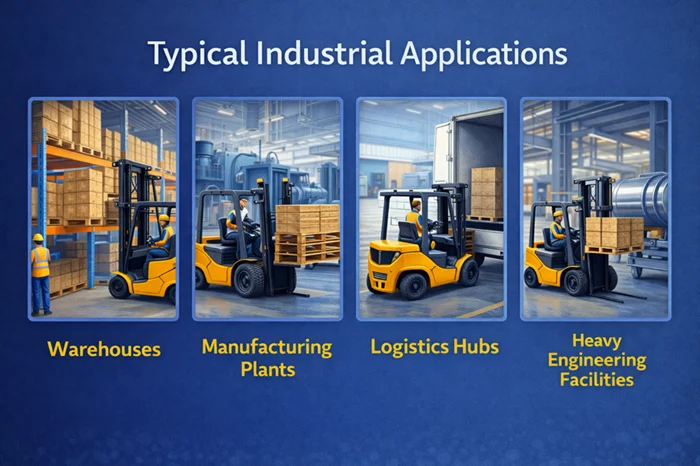
Forklifts are commonly used in:
Warehouses
- Pallet stacking
- Rack loading and unloading
- Order picking support
Manufacturing Plants
- Raw material handling
- Inter-departmental material transfer
- Machine feeding
Logistics Hubs
- Loading and unloading trucks
- Cross-docking operations
Heavy Engineering Facilities
- Handling fabricated structures
- Moving heavy assemblies
Each environment places different demands on forklift configuration and capacity.
Types of Forklifts Used in Industrial Applications
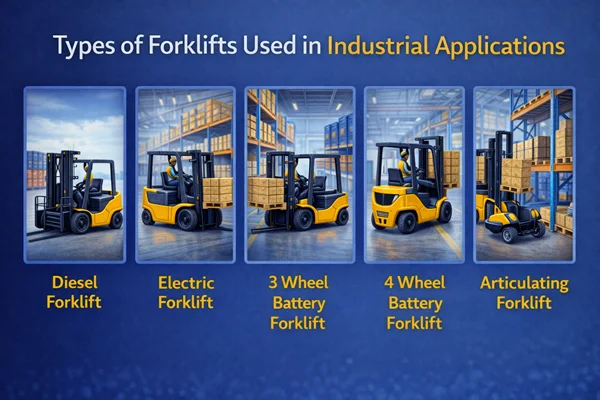
Different industrial layouts require different forklift configurations.
Diesel Forklift
Working Principle
Diesel forklifts use internal combustion engines to generate power. The engine drives hydraulic systems that control mast lifting and vehicle movement.
Best Suited For
- Outdoor operations
- Heavy-duty applications
- Rough yard conditions
- High load capacities
Diesel forklifts are typically chosen for operations requiring robust power and extended runtime.
Electric Forklift
Working Principle
Electric forklifts operate using battery-powered electric motors. The motor drives hydraulic systems for lifting and traction.
Best Suited For
- Indoor warehouse operations
- Noise-sensitive environments
- Clean production facilities
- Food and pharmaceutical industries
Electric forklifts eliminate exhaust emissions and offer smoother control in enclosed areas.
3 Wheel Battery Forklift
Working Principle
Three-wheel forklifts use a single rear wheel pivot for steering, providing enhanced maneuverability.
Advantages
- Tight turning radius
- Suitable for narrow aisles
- Effective in compact warehouse layouts
These forklifts are ideal for facilities with limited space.
4 Wheel Battery Forklift
Working Principle
Four-wheel forklifts provide greater lateral stability due to a wider wheelbase.
Advantages
- Higher load stability
- Better performance on uneven surfaces
- Suitable for medium to heavy loads
These forklifts are preferred when load stability is a primary concern.
Articulating Forklift
Working Principle
Articulating forklifts feature a pivoting chassis, allowing the vehicle to bend during turns.
Best Suited For
- Narrow aisle warehouses
- Space-constrained facilities
- High-density storage systems
They enable efficient movement where traditional forklifts cannot operate effectively.
Key Factors to Consider Before Choosing a Forklift
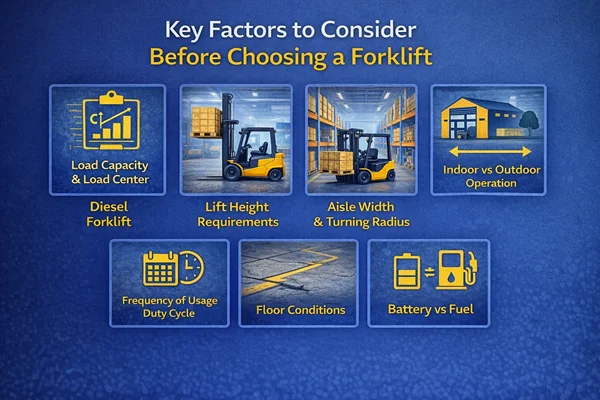
Forklift selection must be application-specific. The following parameters are critical.
Load Capacity Calculation
Forklift load capacity is determined by:
- Rated capacity at specified load center
- Weight of the load
- Attachment weight (if applicable)
In Indian industries handling varied load sizes, accurate load estimation prevents instability and structural stress.
Forklift Load Center Concept
The load center is the distance from the fork face to the center of gravity of the load.
If:
- Load center increases → Effective capacity decreases
- Load extends beyond rated center → Stability risk increases
Understanding this concept is essential for safe operation.
Lift Height Requirements
Evaluate:
- Maximum stacking height
- Rack height clearance
- Mast collapsed height (for doorways)
Incorrect lift height specification leads to operational constraints.
Aisle Width and Turning Radius
Warehouse layout must be measured precisely. Factors include:
- Aisle width
- Rack configuration
- Turning radius of the forklift
Selecting a forklift without layout evaluation may lead to maneuverability issues.
Indoor vs Outdoor Operation
- Indoor → Electric forklifts are typically more suitable
- Outdoor → Diesel forklifts often perform better
Environmental conditions influence drivetrain selection.
Frequency of Usage and Duty Cycle
High-frequency multi-shift operations demand:
- Robust drivetrain
- Enhanced cooling systems
- Industrial-grade components
Light-duty forklifts may not withstand heavy continuous use.
Floor Conditions
Evaluate:
- Concrete strength
- Surface levelness
- Ramp gradients
Poor floor assessment increases wear and accident risk.
Battery vs Fuel Considerations
Selection depends on:
- Infrastructure availability
- Charging facilities
- Ventilation conditions
- Operational shift patterns
Battery planning must align with production schedules.
Forklift Load Capacity and Stability Explained
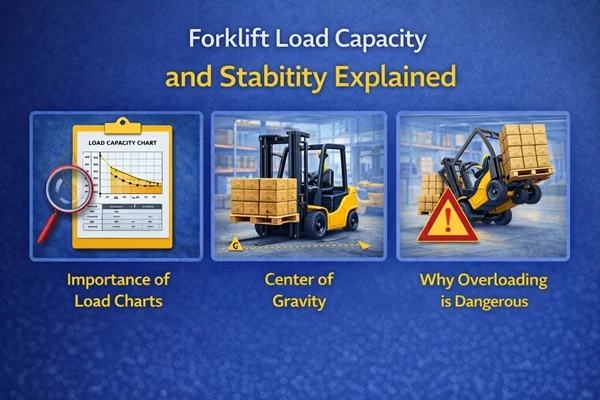
Understanding stability principles prevents accidents.
Importance of Load Charts
Each forklift is supplied with a load chart specifying:
- Maximum rated capacity
- Lift height limitations
- Capacity variation at different load centers
Ignoring load charts compromises safety.
Center of Gravity Concept
The combined center of gravity must remain within the stability triangle formed by the front wheels and rear pivot point.
When the center shifts beyond this triangle, tipping occurs.
Impact of Attachments
Attachments such as clamps or rotators alter load center and reduce rated capacity. Recalculated capacity must be considered before deployment.
Why Overloading Is Dangerous
Overloading can cause:
- Forward tipping
- Mast failure
- Hydraulic stress
- Structural fatigue
Even temporary overloading reduces long-term reliability.
Forklift Safety Features That Should Never Be Ignored
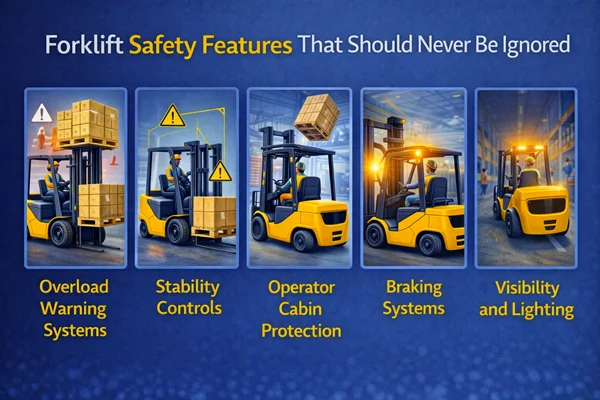
Industrial forklift safety features are critical.
Overload Warning Systems
Alerts operators when load exceeds rated capacity.
Stability Controls
Maintain balance during lifting and cornering.
Operator Cabin Protection
Protective overhead guards prevent injury from falling objects.
Braking Systems
Reliable braking reduces risk in high-traffic warehouse zones.
Visibility and Lighting
Adequate lighting improves safety in dim storage areas.
In Indian warehouses where mixed pedestrian traffic is common, these features significantly reduce risk exposure.
Diesel vs Electric Forklift – Which Is Better for Industrial Use?
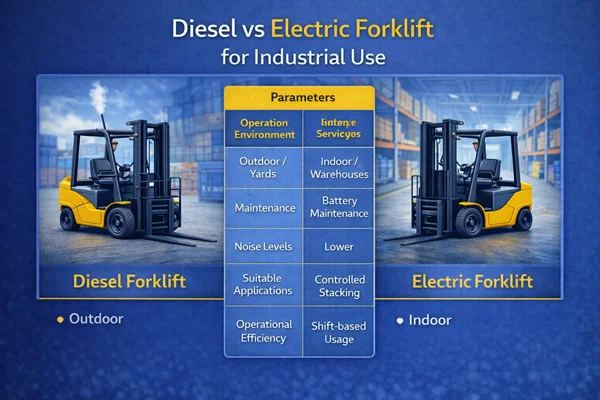
| Parameter | Diesel Forklift | Electric Forklift |
|---|---|---|
| Operation Environment | Outdoor / Yards | Indoor / Warehouses |
| Maintenance | Engine-based servicing | Battery & electrical systems |
| Noise Levels | Higher | Lower |
| Suitable Applications | Heavy-duty loads | Controlled indoor stacking |
| Operational Efficiency | Long continuous runtime | Efficient for shift-based operations |
The choice depends entirely on operational environment and duty cycle.
Common Mistakes Industries Make While Selecting Forklifts
- Underestimating load requirements
- Ignoring aisle width limitations
- Choosing based on price instead of application
- Overlooking preventive maintenance planning
- Buying non-industrial models for heavy-duty tasks
These mistakes increase long-term operational cost and safety risk.
When Do You Need a Customized Forklift Solution?
Customization becomes necessary when:
- Loads are oversized or non-standard
- Specialized attachments are required
- Operations occur in high-temperature environments
- Heavy continuous multi-shift operations are involved
Customized engineering ensures equipment aligns precisely with application needs.
Why Manufacturer-Engineered Forklifts Matter
Manufacturer-engineered forklifts focus on:
- Structural integrity under rated loads
- Accurate load center calculations
- Compliance alignment with industrial safety expectations
- Long-term durability in demanding environments
- Lifecycle reliability
Engineering-based design reduces unexpected failures and ensures consistent performance.
Conclusion
Choosing the ideal forklift for industrial applications requires careful evaluation of load characteristics, facility layout, duty cycle, safety requirements, and environmental conditions. A forklift is not merely a transport vehicle—it is a critical component of industrial material flow.
A safety-first, application-driven selection process ensures:
- Stable operations
- Reduced downtime
- Compliance alignment
- Long-term performance reliability
Careful technical evaluation today prevents operational and safety challenges tomorrow.