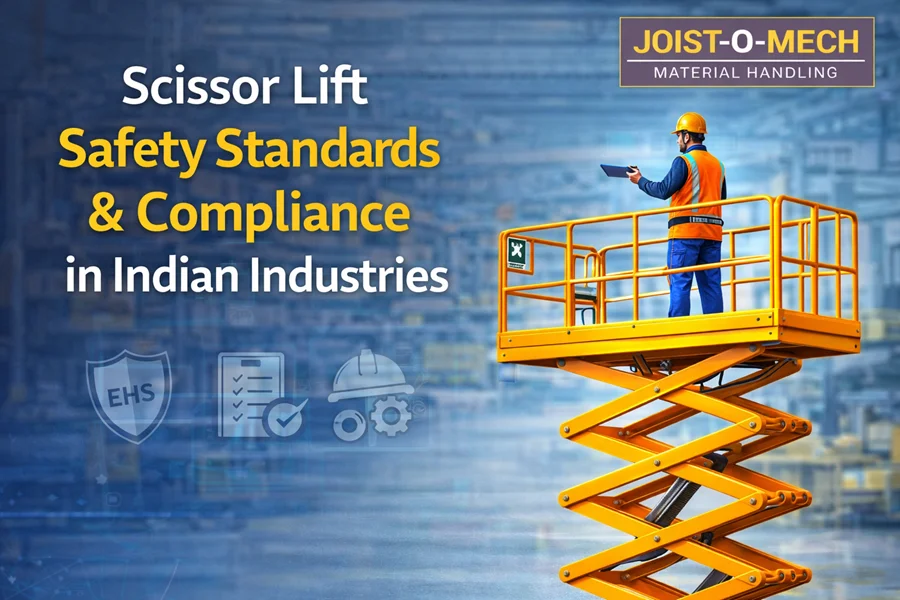
Industrial lifting operations involve inherent risks, especially when work is performed at height. In factories, warehouses, and logistics facilities across India, scissor lifts are widely used for maintenance, material positioning, inspection, and assembly tasks. While these platforms significantly improve productivity and ergonomics, they also introduce safety responsibilities that cannot be overlooked.
Over the last decade, Indian industries have seen a stronger focus on EHS (Environment, Health, and Safety) compliance, driven by regulatory expectations, workforce safety awareness, and operational risk management. In this context, scissor lift safety standards and compliance are no longer optional—they are a fundamental requirement for responsible industrial operations.
This article explains scissor lift safety standards and compliance in Indian industries, focusing on practical safety expectations, common risks, compliance practices, and how properly engineered equipment supports long-term safety.
Why Scissor Lift Safety Is Critical in Industrial Environments
Scissor lifts operate in zones where people, materials, and machinery interact closely. Any failure—mechanical, operational, or procedural—can result in serious incidents.
Common Risks in Industrial Lifting
- Falls from elevated platforms
- Platform instability due to uneven loading
- Overloading beyond rated capacity
- Pinch and crush hazards in the scissor mechanism
- Accidental movement in congested factory areas
These risks increase significantly in Indian industrial environments where:
- Multiple shifts operate continuously
- Floor space is often shared between people and equipment
- Operators may vary in skill and experience
Consequences of Non-Compliance
Failure to follow scissor lift safety standards can lead to:
- Worker injuries or fatalities
- Production downtime
- Legal and regulatory action
- Loss of workforce confidence
- Long-term reputational impact
Beyond compliance, safe scissor lift usage directly affects operational continuity and productivity.
Overview of Scissor Lift Safety Standards in India
India does not rely on a single rulebook for scissor lift safety. Instead, compliance is shaped by factory safety expectations, EHS policies, and employer responsibility.
Factory Safety Expectations
Factories are expected to:
- Use equipment suitable for industrial loads and duty cycles
- Maintain equipment in safe operating condition
- Prevent unsafe access to hazardous zones
- Ensure lifting platforms are stable and protected
Role of EHS Policies
EHS frameworks within Indian industries typically require:
- Risk assessment before introducing lifting equipment
- Defined safe operating procedures (SOPs)
- Regular inspection and maintenance
- Training and authorization of operators
Employer Responsibility
Ultimately, responsibility lies with the employer to ensure:
- Equipment is safe by design
- Operators are trained and supervised
- Safety systems are not bypassed
- Preventive measures are in place
Compliance, therefore, is practical and operational, not just procedural.
Key Safety Features Required in Industrial Scissor Lifts
Safety in scissor lifts begins with engineering. Certain features are essential for compliance and risk reduction.
Guardrails and Toe Boards
Guardrails protect operators from falls, while toe boards prevent tools or materials from slipping off the platform. In busy factory environments, these features protect both the operator and personnel below.
Emergency Stop Systems
Emergency stop controls allow immediate shutdown in case of malfunction or unsafe conditions. Quick response capability is critical in industrial environments where reaction time can prevent escalation.
Overload Protection
Overload protection prevents lifting beyond rated capacity. This feature is vital because overloading is one of the most common causes of scissor lift instability and structural stress.
Platform Stability and Anti-Tilt Mechanisms
Stability systems ensure the platform remains level during lifting and lowering. In Indian factories, where floor conditions may vary, stability mechanisms play a key role in safe operation.
Controlled Lifting and Lowering
Smooth, controlled movement reduces shock loads, prevents sudden drops, and improves operator confidence—especially during repetitive industrial tasks.
Compliance Requirements for Scissor Lifts in Indian Industries
Compliance is not limited to equipment features; it also includes operational discipline.
Operator Safety Obligations
Operators must:
- Follow defined SOPs
- Respect load limits
- Use safety equipment correctly
- Report abnormalities immediately
Equipment Inspection Requirements
Regular inspections help identify:
- Wear and fatigue
- Hydraulic or electrical issues
- Structural damage
- Safety feature malfunction
Inspection schedules should align with usage intensity.
Documentation and Safety Checks
Maintaining inspection records, maintenance logs, and safety checklists supports accountability and traceability during audits or investigations.
Training and Authorization of Operators
Only trained and authorized personnel should operate scissor lifts. Training reduces unsafe practices and ensures consistent compliance.
Scissor Lift Safety Practices for Warehouses and Factories
Practical safety measures form the backbone of compliance.
Pre-Operation Inspection Checklist
Before use, operators should verify:
- Platform condition
- Guardrail integrity
- Emergency stop functionality
- Signs of leakage or damage
Safe Operating Procedures
Safe practices include:
- Keeping platforms uncluttered
- Avoiding sudden movements
- Maintaining safe distances in congested areas
Load Handling Best Practices
Loads must be evenly distributed and within rated capacity. Uneven or shifting loads increase tipping risk.
Use in Congested Industrial Environments
In shared workspaces, scissor lifts must be operated with awareness of nearby personnel and equipment movement.
Common Scissor Lift Safety Violations in Indian Facilities
Certain unsafe practices are frequently observed.
Overloading Platforms
Exceeding rated load capacity compromises stability and structural integrity.
Bypassing Safety Devices
Disabling limit switches or safety locks undermines built-in protections.
Using Non-Industrial Lifts for Heavy Tasks
General-purpose or non-industrial lifts are not designed for continuous factory use.
Lack of Operator Training
Untrained operators often misuse controls or ignore safety protocols, increasing risk.
These violations typically stem from lack of awareness rather than intent, highlighting the need for systematic safety programs.
Role of Operator Training in Scissor Lift Safety
Training is one of the most effective risk-reduction tools.
Why Trained Operators Reduce Incidents
Trained operators:
- Understand equipment limitations
- Follow SOPs consistently
- Respond correctly to abnormal conditions
Importance of SOPs
Clear SOPs standardize safe practices across shifts and departments.
Safety Accountability in Indian Factories
Defined responsibilities encourage compliance and reduce ambiguity during incident reviews.
Maintenance and Inspection for Safety Compliance
Equipment safety degrades without maintenance.
Preventive Maintenance Importance
Scheduled maintenance prevents failures and extends equipment life.
Inspection Frequency
Inspection frequency should reflect:
- Usage intensity
- Load severity
- Environmental conditions
Maintenance and Long-Term Safety
Well-maintained scissor lifts operate predictably, reducing emergency situations and unplanned downtime.
When Customized Scissor Lifts Improve Safety Compliance
Standard equipment may not suit all applications.
Customization improves safety when:
- Loads are non-standard or uneven
- Space is restricted
- Equipment integrates with production systems
- Operations run continuously under high stress
Customized designs align equipment with real operating conditions.
Why Manufacturer-Engineered Scissor Lifts Support Better Compliance
Manufacturer-engineered scissor lifts focus on:
- Structural integrity under industrial loads
- Accurate load calculations
- Built-in safety systems
- Consistent performance over long service life
Engineering-driven design supports predictable compliance, rather than reactive fixes.
Conclusion
Scissor lift safety standards and compliance in Indian industries are essential for protecting workers, maintaining productivity, and meeting EHS expectations. Safety is not achieved through equipment alone—it is the result of proper design, disciplined operation, regular maintenance, and trained personnel.
Industries that adopt a proactive, safety-first approach reduce incidents, improve operational confidence, and build long-term resilience. Compliance should not be viewed as a burden, but as a foundation for sustainable industrial growth.